An Afeela Out Of Time
Are we surprised the equivalent of an NIST standard electric car would be dead on arrival even if it wasn't of it's own doing?

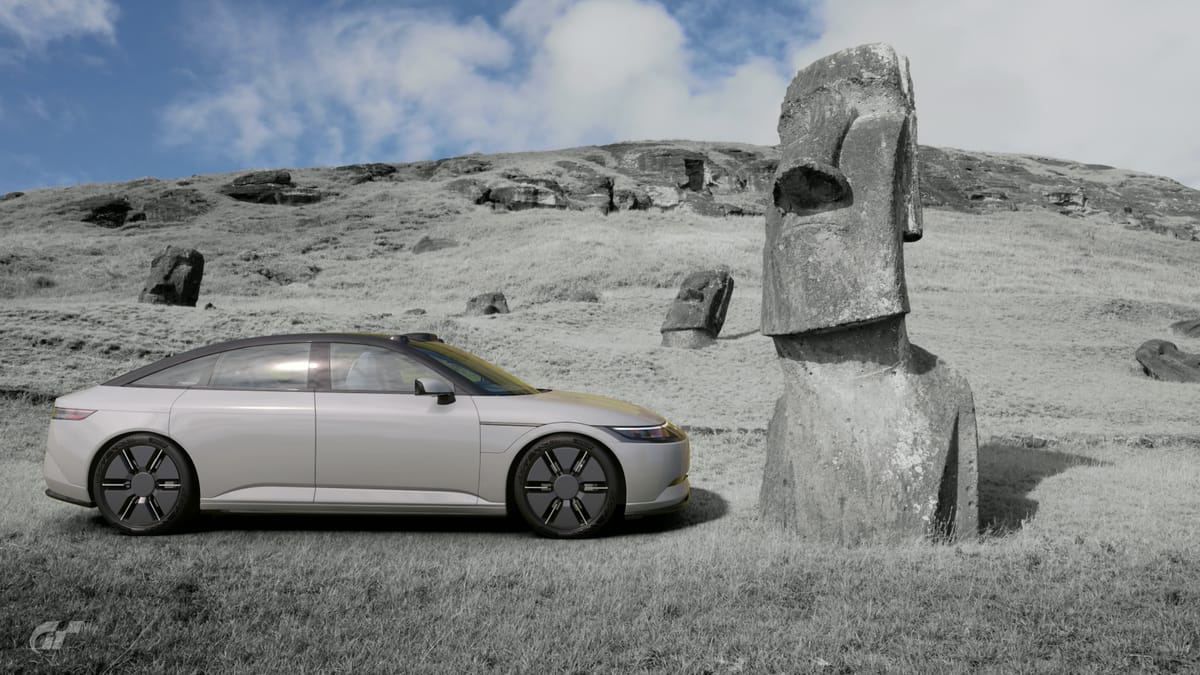
The AFEELA 1, a creation of Sony and Honda via their joint corporation called Sony Honda Mobility Inc., is dead. As a part of Honda reassessing their strategy regarding electrification, some of the tooling and technology at the core of the operation would no longer be provided by Honda as was originally planed for the venture; which leaves SMH in between a rock and a hard place. The Afeela 1 in effectively it's launch specification, and a prior prototype, are available to drive, customize and race in Gran Turismo 7 and may be as close to the light of day the car and the joint venture will ever get. The real version of the Afeela was probably months away from being in the hands of those who pre-ordered it.
This comes as the price of gasoline has jumped up a dollar per gallon on average in the United States in the last month off the back of their illegal bombing of Iran at the behest of the genocide state of Israel. In my home province of British Columbia, the price of regular has jumped to above two dollars per liter but without the Carbon Tax revenue flow for the province that was in place the last time the cost was this high. At this time the only fully electric Honda on the market in North America is the Prologue: a badge engineering job to get something out the door done as a part of their partnership with General Motors.
This comes as the cost to buy an Afeela 1 was north of ninety thousand dollars, while the cost of effectively everything else has continued to increase since 2020 with wages continuing to fail to keep up. Electric vehicles from Nissan, Hyundai and Toyota are tens of thousands of dollars less while a Lucid Air with nearly triple the power output and significantly more range can be bought for a similar price. Notable among all this is the lack of true affordable electric cars in North America; though that may be changing in Canada depending on the extent of what BYD and Cherry bring from China. At least they're giving full refunds for those who did order the Afeela 1.
This comes as the car itself gives of the impression that electric cars still have to be seen as a curiosity and different to their internal combustion counterparts. In this case it comes from the Afeela 1 being completely devoid of character and a soul of it's own, with this being by design. With the press release announcing the discontinuation using mobility products instead of automobile, it gets across the idea of such a car being seen as an appliance a little too on the nose. As e.w. neidermayer pointed out on Bluesky, it does feel like a NIST standard electric car. If you've driven either the launch model or the prototype in Gran Turismo 7, it certainly drove and performed the part too. How good would the passenger experience have to be to make it a worthwhile purchase in spite of the paltry performance and uninspired design at that price point?
The Afeela 1 and this overall venture between Sony and Honda do not feel like something out of the 2020s, it feels like something from a decade ago. It feels like a tech startup trying to reinvent the automobile by inventing the automobile. But it's 2026; and what we got is a car and an initiative already left in the dust before they got off the starting line. What was the actual business case and plan for Sony Honda Mobility Inc. if this was what they were putting out? Electric cars as ventures to make stock market value go up rather than be affordable and driven by people are already fading away, as much as Telsa still hums away regardless. The ones that are latest to the party and operating like an innocuous tech startup from ten years ago were surely going to fail, it just so happened to be when two of the biggest names in automotive and tech came together. What happens next for the joint venture, or for Honda's other all-electric cars is anyone's guess after they too were put on death's door.
A more luxury driven electric vehicle from the likes of Honda and Sony may have been a success at the end of the 2010s, but the cost of it remains a massive hurdle to overcome especially with the COVID-19 pandemic right around the corner at that time. I also wonder if a automobile done in partnership with Sony could have made a bigger impact if it was done when they were still titans within the consumer electronics industry both in form, and function. Imagine a all-electric Honda with the forward thinking design and tech of early 2000s Sony, and engineered to be affordable to lease after GM discontinued the EV1. An Afeela of the early 2000s would have been a marvel.
When it comes to their inclusion in Gran Turismo 7, every good automotive museum should have some curiosities and failures. Seemingly overnight, two cars that were already in the game get to have that anecdote added to their display. When you walk towards their exhibit though, the thing that will grab your attention instead will be the Xiaomi SU7 Ultra: a car built by a tech company that knows it's place, and it's time.