BRGoF25 - From Alba to London
Burnout 3: Takedown was a revolution that redefined the idea of what a racing game could be when it was released in 2004.

Welcome to BRGoF25, a look at the Best Racing Games of the First 25 years of the 21st century. A love letter to the titles that defined the genre during this time of immense growth in the industry, transcended boundaries and broke the glass ceiling to become the very best that video games had to offer.
Inspired by Giant Bomb polling their users on what they say is their 10 best games of the 21st century, this series of articles will focus on the racing games that, in my opinion, rubs shoulders with the giants in the industry that make up what GB's users submitted themselves. These are racing games that you should find a way to play for yourself, regardless of your gaming preferences.
"If you have the means, I highly recommend picking one up."
We pick up this story in the north of Italy, with three British gentlemen about to embark on a race back to London; freshly picked truffles in hand. Two of them head off on their respective Vespas to a local airport, but the third has a short walk to his chariot for this trip through Europe. What awaited the tall, oafish fellow was a two-toned behemoth sleek and flowing in nature, but exuding power unlike anything he had seen before on four wheels. Sixteen cylinders and one thousand and one horsepower, capable of going beyond 400 kilometers per hour; something not seen in the world of closed-fendered cars since Roger Dorchy broke the top speed record at Le Mans in 1988. But this was a road car: comfortable and refined in ways never seen before to this extent and to this level of execution. There was no drama or pantomime in the way the Bugatti Veyron became the fastest production car the world had ever seen, and that in it of itself was theater the likes the automotive world had never seen.
There may have been other new supercars at the time, like the Ferrari Enzo and Porsche Carrera GT, but they still existed as refinements of the old way of the supercar: birthed from the rib of the Ferrari F40 and McLaren F1. The Bugatti Veyron stood apart as the way it built it's speed wasn't sharp, violent, and bordering on fragile like it's counterparts. This was a new kind of speed in the realm of the automobile: it was a progressive and grounded surge that did not stop until it hit north of 400 kilometers per hour and did it with a level of composure that gets taken for granted twenty years on. There was nothing like it in 2006, and that was top of mind for Jeremy Clarkson sitting in Tower 42 in London across from Richard Hammond and a now asleep James May after the three of them were in Italy thirteen hours prior.
Jeremey had won the race by mere minutes in the Veyron, but he was very solemn in that moment sipping away on his pint of beer. He knew that the way he would view and drive every car in his life afterwards would have to be weighed against the experience of driving one of the greatest feats of automotive engineering across Europe. He had driven the automotive equivalent of Concorde, and was left to think about the consequences of driving a car so good that the only way forwards for the industry was backwards to protect itself. And even as modern supercars now have surpassed the Veyron in terms of performance capabilities, that first experience of the new way of being for supercars had already been done and those who followed could never capture that raw emotion of the first time. A 250 mile per hour top speed still has incredible impact, but it can't change the world now the way it did twenty years ago.
For a video game to do that, that feeling of changing the paradigm so much that nothing could ever come close, it would take changing the way people played that genre of choice. It would take redefining how the player interacts with the world, and very the nature of the battle that takes place within that world and doing so in a way that makes everything else feel antiquated in comparison. In the world of racing games, it took redefining what it meant to battle your opponents on track. It was now about trading blows, shunting and slamming your rivals in the hope they would wreck in spectacular fashion and using the boost you earned to power away. It was about driving dangerously on purpose, knowing a crash would set you back but the reward for taking those risks would always be worth it. It was the first racing game that had better action than even the best action-adventure games, and the entire gaming world stopped in it's tracks as a racing game had transcended beyond the confines of one of gaming's most time-honored genres and into the realm of all-time greats.
And in it's wake, nothing would be the same. Some of us still chase that feeling of hearing The Lazy Generation by The F-Ups and scoring a Takedown for the first time, and have seen new racing games come and go trying to replicate that feeling but never got it right. Though, one did get close.
It's time to talk about the best racing game ever made, and among the greatest video games ever made.
Up next on my list of the Best Racing Games of the First 25 years of the 21st century: Burnout 3: Takedown.
Burnout 3: Takedown was a revolution that redefined the idea of what a racing game could be when it was released in 2004. The understanding of how a race could shake out had been completely redefined after the old formula had been well and truly sorted out by this time. Prior racing and driving games worked with the idea of your car being a weapon to run into your opponents with, like in Chase H.Q. and the Destruction Derby games, but they hadn't put the whole puzzle together to make it a decisive battle along the way. Each shunt and slam made a loud, metallic crunching noise. Sparks and chunks of the car get sent flying into the air. The car you just gave a open field tackle to lurches to the left or right beyond the control of the driver and potentially into the wall, a median, or into a bus. They've crashed spectacularly by your hand, and the game slows down to show you the destruction you've created. You just got a Takedown, and given a rush of dopamine the likes a racing game has never given you before. But there's more; your boost meter just got a shot in the arm and filled to the brim. The game is telling you to do it again. Find another racer and take them down. You want this feeling, this satisfaction, this bliss of carnage at it's highest octane that makes you feel like Speed Racer during the closing laps of The Grand Prix after his Mach 6 came back to life.
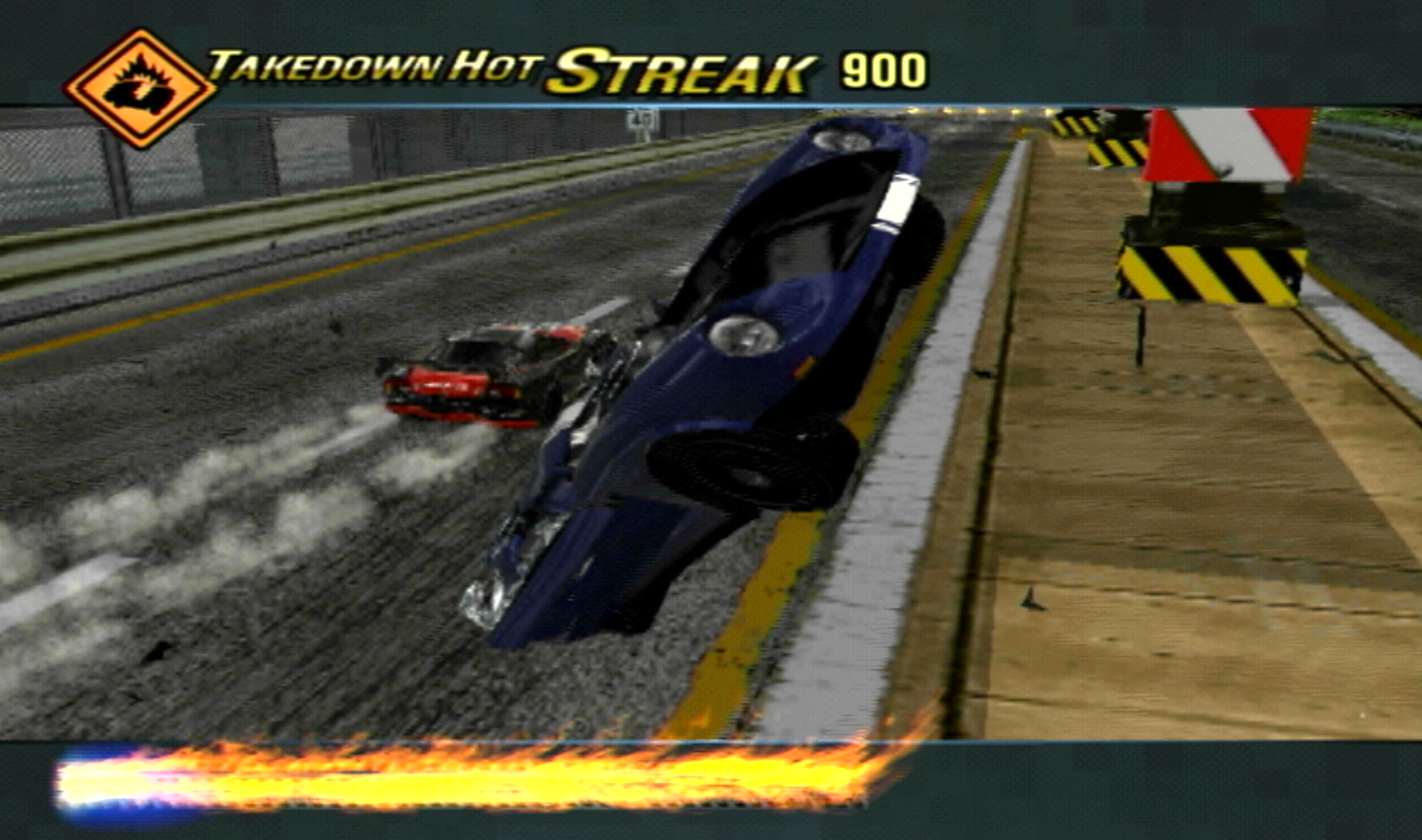
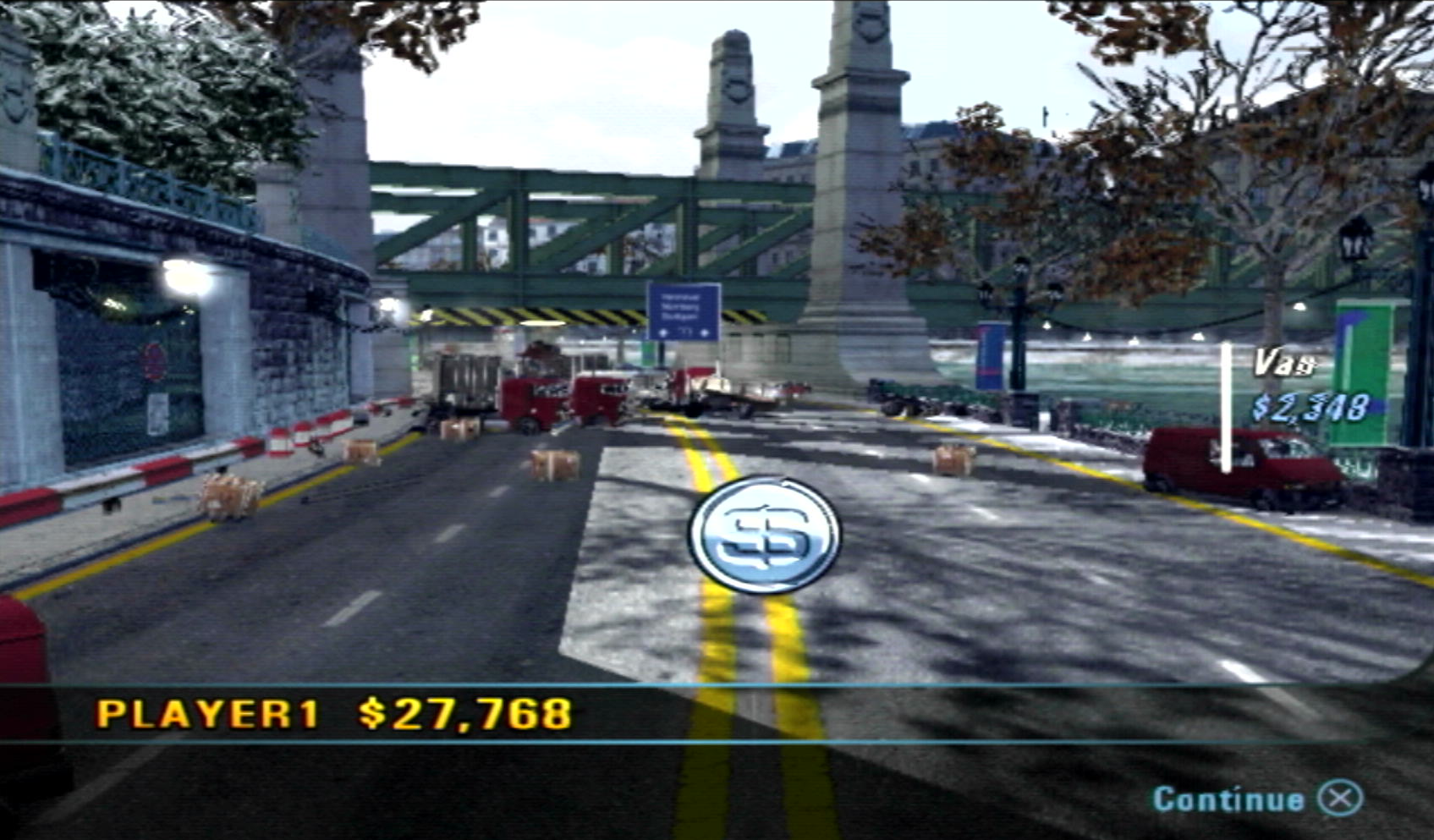
It isn't just the complete re-imagining of how car combat can work in a racing game that sets B3 apart; it's the fact that everything came together on the gameplay front to create a well built and cohesive package start to finish. The Burnout World Tour progression builds in speed and difficulty without dragging it's feet, eventually leading to the challenging open wheel racers at the very end. The Crash World Tour that runs in parallel builds on the mode's own revolutionary introduction in Burnout 2: Point of Impact through the addition of the explosive Crashbraker and the ability to control your car in the air and following a crash using Aftertouch. That second chance for redemption after you do crash or get taken out yourself was that piece needed to get you back in the action sooner: you want to be battling instead of fumbling trying to get back up to speed as was the case in the first two Burnouts.
This is the first time the now more commonplace tap to drift control and driving physics had been perfected; as the smooth initiation and flow of the drift allowed for maneuverability laterally through the corner without worrying about losing momentum. The chase camera, though can be a little too close to the car, lets the front outside corner do most of the rotating as you drift and sways into the drift to allow you to see around the corner. There is a harmony between the tap to drift driving physics and the chase camera that allows you to soar come time attacks and racing, and highlights the refinements made from B2's already excellent driving dynamics. If a racing game uses tap to drift to go around corners, B3 is forever the benchmark and one that Criterion Games themselves failed to continue that form with when it came to Burnout Paradise or their Need For Speed games. It drives that good, and races that good both in terms of the combat and also in a more pure racing sense corner to corner. Alternatively, you can take out all your frustration on some unsuspecting racers in a Road Rage and feel the bliss of taking down your rivals until your car simply has enough. But while your car may have had enough, you will be coming back for more.
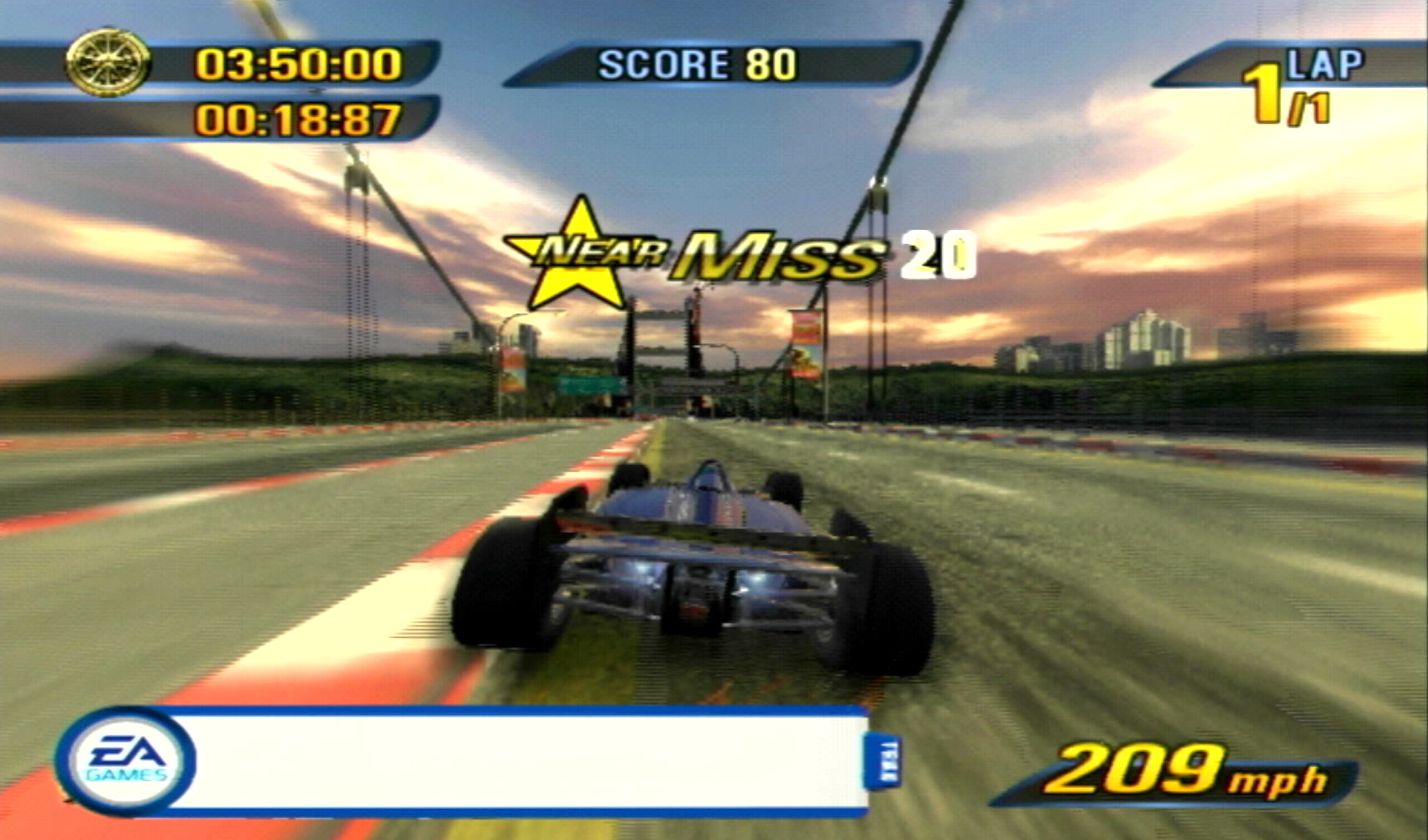
To get to that point, it took a developer to be fully at home with what they were building and capable of maximizing the hardware they were given. Buoyed by the fact that in the game's initial conception that Electronic Arts would be fully hands-off on the endeavor, this was Criterion Games's moment to push the boundaries within their own RenderWare game engine. Improvements in the lighting, particle effects and rendering over B2 in particular were a massive leap forward over the prior two Burnouts that were published in Acclaim's dying days. Burnout 3 maximized that pseudo-realistic graphics style that came to the fore pioneered by companies like 3DFX and did so with rock-solid stability. While B3 doesn't strive for absolute photo realism like Gran Turismo 4 did, it has still visually aged incredibly well off the back of a bright and saturated color palette and a game world packed to the brim and full of life. The sunset skybox on the Tropical Drive track in particular is an incredible piece of graphic design with it's array of blues, purples and oranges as you take the US Circuit Racer on it's preview burning lap.
Working with Electronic Arts did have it's benefits in those early days, as it opened up the possibilities of licensed music to make up the bulk of Burnout 3: Takedown's soundtrack. Personally I will always hold the original soundtracks from the first two titles in high regard, but this soundtrack is truly special in it's own right in terms of matching the game's intensity and energy to perfection. More than forty songs across rock and punk music genres matched the high-tempo and even higher spirits of the on-track action. There is a joie de vivre when it all comes together, and the truest mark of a great licensed soundtrack is when it matches the vibe of the game it's a part of. It, paired with DJ Styker's level of enthusiasm, feels like a celebration in a way: songs like At Least I'm Known For Something from New Found Glory give off a feeling that Criterion knew what they had on their hands when the Summer of 2004 came around. The team based in Guildford knew they hit it out of the park in ways beyond their imagination, and is what made Criterion creative director Alex Ward describe Burnout 3 as "the high point for the studio."
Those comparisons to the Bugatti Veyron and to Concorde come with a cost that cannot be denied. When everything comes together that succinctly and produces a pieces of engineering or programming so perfect that conveys emotions never seen before, everything in it's wake has to deal with that. The Bugatti Chiron may be faster, more luxurious and more visually striking, but it wasn't the one that stepped out of the primordial ooze. The technological revolution that was the Concorde changed what we thought was possible in aerospace, but attempts to better the design and do more in terms of passenger seating and speed would show how easy it is to go too far if you didn't know your place and weren't at peace with what you were capable of. Burnout Revenge couldn't just be Burnout 3 Two, and changes to make the sequels stand out on their own shows what they couldn't be while further highlighting just how special Burnout 3: Takedown really is.
What they couldn't be was that first time. They couldn't be the ones that ignited the spark that changed the world; and in this case, changed racing games forever. For better, or for worse.
Up next on BRGoF25: The first of two games from Nintendo, and their take on racing faster than the speed of sound.