A MRT05 And A Dream
Originally titled, 'The most fun I ever had playing a Formula 1 game," it was time to go fast.

By the time 2016 came around, it had been four years since the last time I had bought a new Formula 1 game. Even in that time, the amount of hours I had spent playing F1 2012 was especially minuscule compared to the first two iterations that Codemasters put out on the main consoles of the era. I had quickly grown dissatisfied at the lack of positive growth and developments in the main Career Mode, before the now recalcitrant force-feedback settings made it hard to find a sweet-spot to enjoy what experience there was. I needed more than just the Young Driver Test to be added to the campaign before I went on my way with HRT for the third year in a row. When I realized that that wasn't going to be the case in future editions, I simply stopped playing Codemaster's F1 games and waited for something to change.
For some time, I had completely written off the F1 games. That wave of momentum that the team from Southam had at the start of the decade had receded just as quick, and by the time F1 2014 and 2015 came around it felt like Codemasters had completely lost the plot across their portfolio. There was signs of new life at the time, as DiRT Rally was a breath of fresh air for off-road racing games, but their big cash cow still felt like it was stuck in the doldrums.
It wasn't fully their fault; by this time they had fully run into the wall that was Formula 1's licensing agreements with little creative runway left. Codemasters did finally get a reprieve, and the restrictions on what they could do had finally started to lift come the middle of the decade. A fresh generation of games consoles was now getting fully understood from a development standpoint, giving a much needed opportunity for a second chance and a rebirth of the franchise.
For me to believe in that rebirth, I needed a pull. I needed something to grab me and make me believe that the future was going to be different, and better. A real effort needed to be made to shed my cynical belief that the future would refuse to change. Codemasters put in that effort and gave me something to believe.
It was a trailer, not even a minute in length, with an orchestral score that would build in intensity before peaking as the cars rolled onto the grid showed that Codemasters had done something they were truly proud of. It was a agent handing you her business card and a technical director shaking your hand and welcoming you to the Renault F1 Team that showed that efforts in the right places were being made in earnest. It was the Scuderia Toro Rosso and that same Renault having numbers of driver's not on the F1 grid that showed that things had finally changed, and that your place in F1 had more meaning than it ever had in any game that preceded it. There was other features and elements making their presence known, like the return of being able to drive the formation lap for the first time in a decade and the Virtual Safety Car, but the me of the past already had his mind made up. This was the time to get back into playing Formula 1 games, but there was more to come in the weeks before launch.
A little bit more information about the refreshed Career Mode would come out before launch, showing off a development race that every team was involved in and showing for the first time in any F1 game the actual performance spread of the field. The new development race meant that the Career Mode was fluid beyond what you did, and made each person's experience truly unique in ways previously only possible in the EA Sports NASCAR titles. That screen that showed the performance spread was also where you purchased car upgrades for your team, with there being five upgrade categories and each getting five upgrades. It was the nature of those upgrades, being horsepower, fuel efficiency, chassis weight, aerodynamic downforce as well as drag, that would launch the idea for how I tackled my foray in the Career Mode. To get to the origins of that idea, we have to go back to the year that Codemasters's actual first F1 title of this era came out.
I had always watched Formula 1, but never watched the sport until I was a little older. I was never actively following the so-called pinnacle of motor racing, but that changed when I started to tune out from NASCAR in the latter half of the 2000s. Different series were now filling that void, and SPEED did have F1 as well as the American Le Mans Series and the then-called SPEED World Challenge on their schedule. Though I marveled at the nature of the aerodynamic developments happening in 2008, it would be 2009 that was the first Formula 1 season I was fully tuned-in for.
In the early days of 2009, it was all about Brawn GP rising from the ashes of Honda paired with the complete change in that performance spread off the back of the biggest aerodynamics changes the sport had ever seen up to that point. Such a refresh and the intrigue of how Brawn would pan out after their hot start was enough to get me in the door, but there was more going on up and down the grid. McLaren and Ferrari were now fighting for their life for points early on, after sacrificing development time to focus on the championships the year prior. They were now fighting the then newest team on the grid in Force India to try and make it into the second round of qualifying. Oh how the tables had turned against the best from 2008, but what about that team now adorned in white, orange and green that they were battling?
Vijay Mallya bought a team that had gone through two new owners in short order after Eddie Jordan sold the team that bared his name. He had also inherited a car and it's design principals that were stuck at the back of the grid with little upside, but was given a golden chance to change those fortunes. Everyone was given a chance to work with a clean slate and redefine how they're car would be on track with completely new aerodynamic principals. The VJM02 was still at the back of the field, but had a better platform to build from with it's Mercedes-Benz engine and one of the main issues of past cars from the Silverstone-based squad having been addressed.
Normally, if your car in Formula 1 doesn't have the downforce to be at the front of the field it can be implied that it's not manipulating the air as much on the straightaways in a negative way if it's also not doing so positively in the corners. Theoretically it's able to slip through the air a little bit better after not being dragged back as much by the dense mass of air that it gets through at speed, though it might only be worth a few kilometers an hour. This wasn't the case with the first Force India car, or the Spyker or Midland that preceded it; a combination of lower downforce and higher aerodynamic drag would be impossible to overcome if it wasn't for the chance to wipe the slate clean.
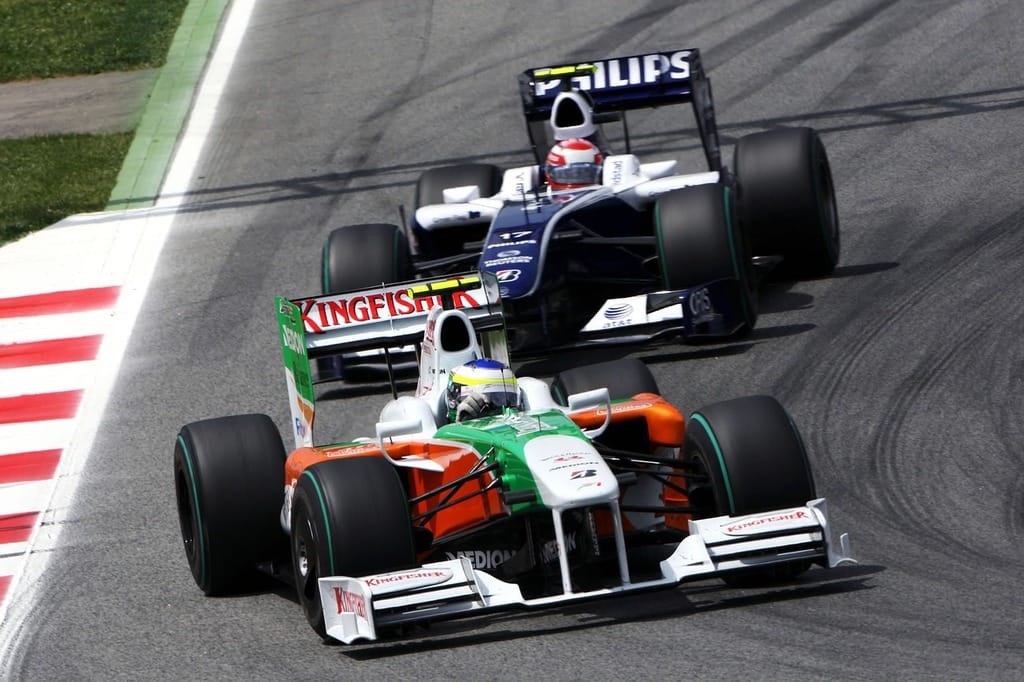
Force India's 2009 car still didn't have a lot of downforce within the pecking order initially, but it now didn't have that absurd amount of parasitic drag holding it back on the straights. The team gave themselves a new direction to develop from, while still being able to maintain a new advantage that they had successfully made for themselves; it just took time for that to bear fruit with there only being two tracks on the schedule in 2009 where you wanted maximum top speed. But when it was time for Spa-Francorchamps and Monza, it was no fluke that Giancarlo Fisichella would finish second behind a resurgent Ferrari of Kimi Raikkonen in Belgium while teammate Adrian Sutil finished fourth in Italy a couple weeks later. Force India built a car to be a straight line missile the one year where doing that would pay off, and it left such a lasting impression on me to where the VJM02 remains one of my favorite F1 cars. I had wondered if I ever would have the opportunity to make such a car for myself in the virtual world.
I wanted to make a car that could walk away from the ai on the straightaways; and seven years later, that chance finally came.
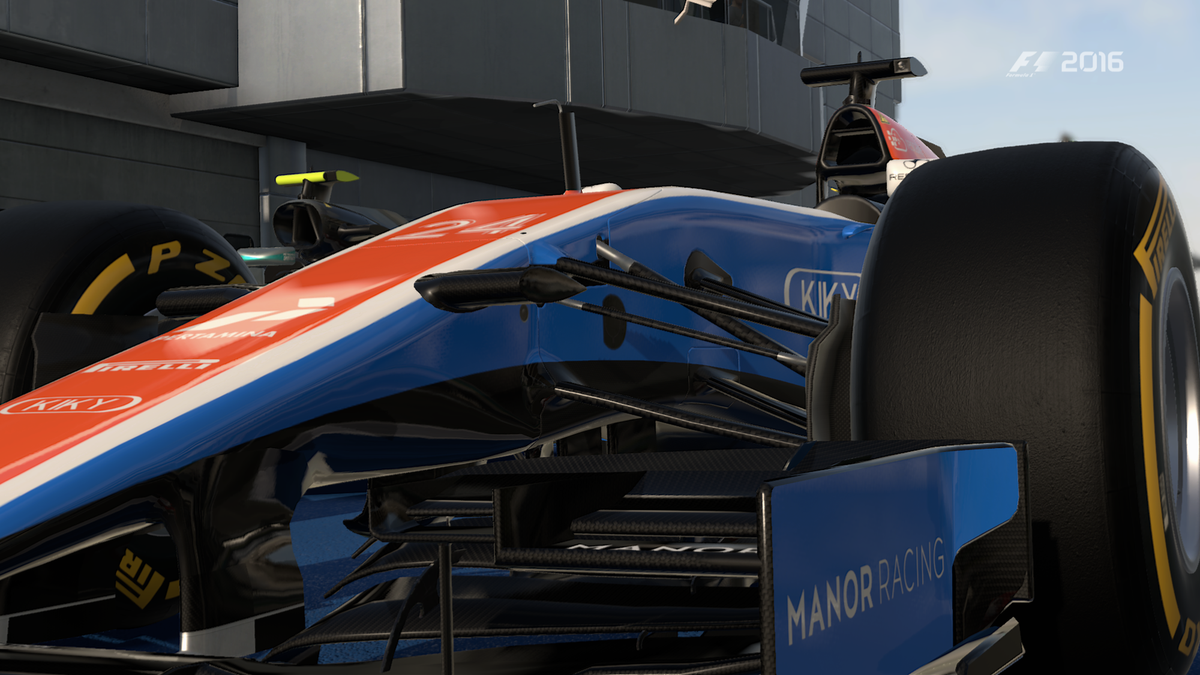
The last of the true Formula 1 underdogs was still in the sport in 2016, and they had finally bridged what felt like a impossible pace gap when they had entered as Virgin Racing in 2010. Though still occupying the last row on the grid on occasion, Manor Racing's MRT05 still lacked raw downforce, but was still a lower drag package that now had the added benefit of the best power unit in the field. The combination was good enough to get Pascal Wehrlein into the second round of qualifying on multiple occasions, and a single point at the third high-speed track on the schedule on the Red Bull Ring. But this is the virtual world, and we can get a whole lot more than just a single point.
The plan was simple: priorities the investment of the development points earned from the practice programs into making my Manor MRT05 into the scariest straight line missile I possibly could. Maximize the aerodynamic drag and horsepower upgrades, don't touch the downforce and do fuel efficiency or weight upgrades when the opportunity arises. To make a well-rounded car would be too easy and too boring; I just wanted to go fast. Sergio Perez and Valtteri Bottas hit 370 km/h at the Mexican Grand Prix that year, that was the goal in as many places as I could and to get points and wins at the dedicated temples of speed. I wouldn't have it any other way in this renewed Career Mode in the Codemasters F1 game.
There was enough races on the 2016 schedule to get the upgrades flowing in before the challenge run's first real race. Six races to start the season before the first of these speed-focused tracks came into view, with Circuit Gilles Villenuve the first in a run of three races with the debuting Baku City Circuit next, and the Red Bull Ring after that. The overall loose nature of F1 2016's driving dynamics meant I could only manage third in the first points paying result of the year in Montreal, before using a late safety car to get fresh tires, pass four cars on track, and take the win in an effective green-white-chequered finish in Azerbaijan.
Even in the struggles of Sochi and Barcelona before that first breakthrough, the speed charts had already showed a major shift in that part of the performance dynamic on track. The full trap speed information isn't available in the game, but you can deduce that part of the pecking order from spectating the field during practice. Felipe Massa and his Williams were often in the top five in the speed trap, alongside the Ferrari and Mercedes drivers but none of them were ever occupying the top of the speed charts. The plan had already shown to work, but the trick with any development race is to keep the hammer down even when you know you have an overwhelming advantage.
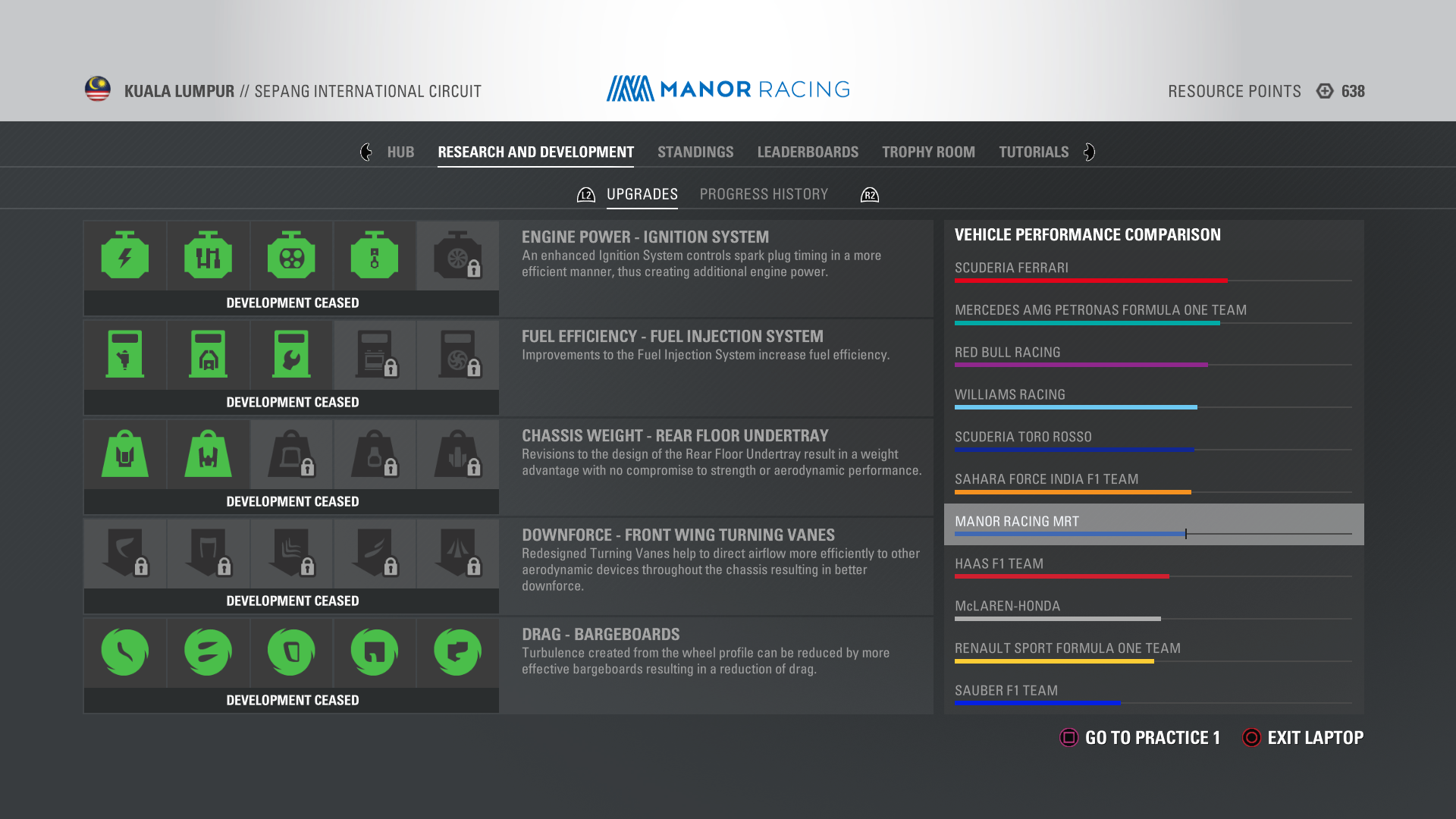
More points paying finishes would follow as the upgrades piled up, as deliberately not touching the downforce upgrades allowed everything else to reach higher levels than likely expected in the first year of a Career Mode. Before pausing development and banking the upgrade tokens for a second season, I had ended up with the maximum upgrade for aerodynamic drag, four of the five engine power upgrades, and a couple upgrades to fuel efficiency and car weight thrown in there. It was enough to bring the Manor firmly into the midfield with a nasty surprise for those ahead on the tracks where straight line performance mattered, and it even gave Pascal Wehrlein a few points to his name too.
But I never reached the most desired test of them all when I played F1 2016 at launch.
I had dominated the Italian Grand Prix at Monza, survived the Singapore Grand Prix, and then the story stopped. Other games, including the first beta for Gran Turismo Sport, took my attention and by the time I could have come back to finish what I had started F1 2017 was already on the horizon. Past me was also dreading the trio of tracks coming next: being Sepang, Suzuka, and Circuit of The Americas. I never meshed with this physics set with how loose it is on lateral weight transfer and on initial power application, which gets amplified with the lack of downforce in the Manor MRT05. I saw how much of a nightmare the middle sector of Sepang was in opening practice, and it was enough to push me over the edge to simply move on. I never did make it to Mexico City and race on all the high speed tracks like I had intended ten years ago.
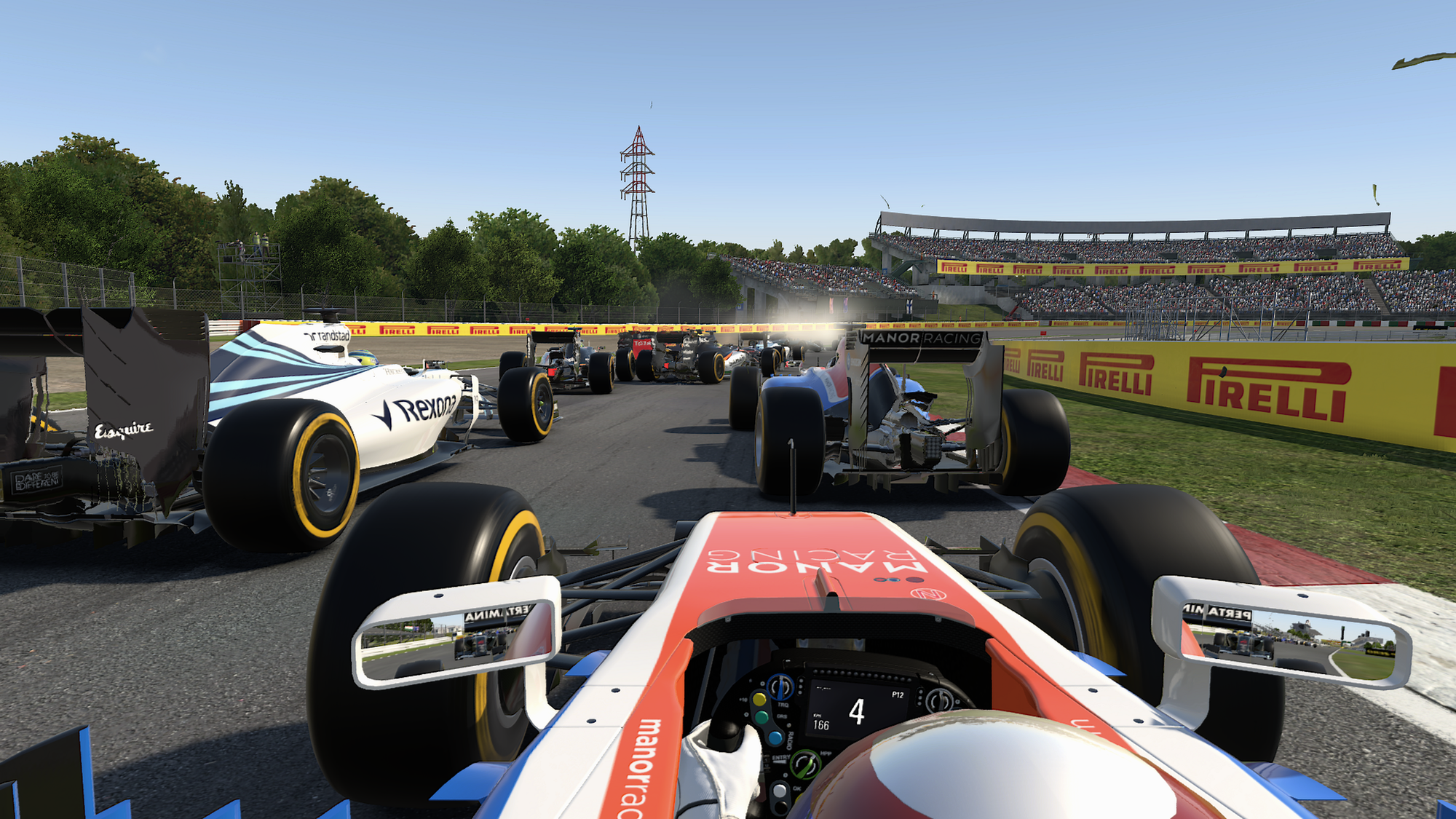
But now, it was time to right that wrong and chase the top speed record. I had to make it to the first practice session in Mexico to see what I could truly do fully trimmed out. The three weekends prior were a slog, but the reduced air density at altitude and the 1.2 kilometer long front straightaway at Autódromo Hermanos Rodríguez was the payoff. I wasted no time taking all the downforce off the front and rear wing in the setup menu, and set off on the Track Acclimatization program with a purpose. No threat of damaging the engine like in future iterations, just see how fast I could go before having to brake for turn 1.
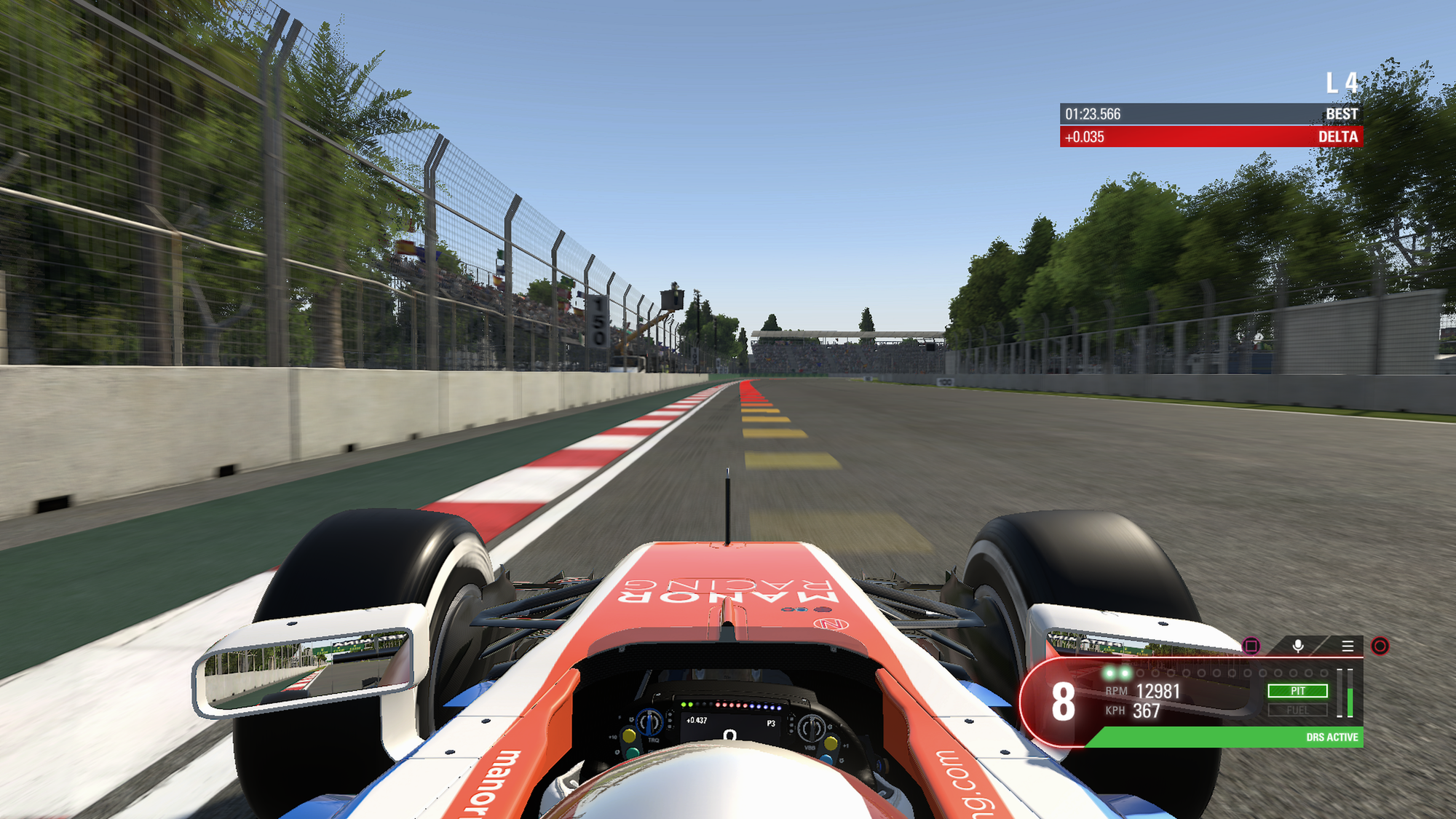
The answer with no draft, DRS and full power: 367 kilometers per hour, or a touch over 228 miles per hour, before having to brake for turn 1. Sergio and Valtteri were only able to go 3 kph faster with a draft in the real deal during the Mexican Grand Prix, and I was a full 15 kph clear of second fastest in the speed trap. It was clear the MRT05 was running out of steam north of 360 kph, but it was everything I could have wanted it to be. I could dial back some wing to make the middle sector tolerable come qualifying and the race, but I got my fix. The me of the past never got to see what was truly possible with the season he started, but it doesn't mean the me in the now couldn't finish his story. There was still a few more races to go before all those development points I've been saving could be unleashed in season 2, but it was all about the joy of seeing my brainchild at it's absolute limit.
Hitting that speed in first practice, that was enough. It was everything I could have wanted it to be.
Things would, however, change in the following F1 releases from Codemasters. The linear progression for each of the upgrade categories would go away, and be replaced with a branching path system with more specific parts to be upgraded along the way. The possibility to do a low-drag, high speed build was now an impossibility with access to such upgrades locked away deeper in the upgrade path, and further locked by needing higher level facilities in the games that would follow. Much more of the emphasis was building a more balanced machine and then taking advantage of any regulation changes that might catch out other teams, rather than that fleeting moment when you could truly make a car that stands out on it's own. This is how the development, upgrading and the core of the Career Mode has been in the Codemasters F1 games ever since, though the visuals of the R&D tree has gone through makeovers to mask the lack of positive progress in the game's primary single player mode when getting beyond the first few years of a campaign. It's why I never made it as far as I did in future Career Mode attempts as I did in F1 2016, and the attempts to do a challenge run of not passing the factory team's engine development level wasn't enough to keep me pulled.
But for a brief moment, they had me. They had me believe the car that I was building was truly my brainchild. It's a kind of sovereignty that's possible in the virtual world if we allow it to, and only possible in the real for a brief moment when we're in the discovery phase of a new formula. Eventually every team in Formula 1 reaches the same conclusions about how to be fast with varying levels of success in their execution, and for this last decade so has the video games that seek to replicate the sport. Perhaps the fact that the games are able to do that now is worthy of recognition in it of itself, although I will forever wish to branch my own path in how to be fast with no hard ceilings with how many upgrades are possible and what could be upgraded.
The rebuilding year that is currently taking place at Southam may hold the ticket to redefining what the primary time sink of a Formula 1 game could be again; much like it did a decade ago for me at the helm of the last of the true underdogs.